
Whole House Air Filtration vs. Standard HVAC Filters: What’s the Difference
Every time your heat turns on in the winter, or your cooling system activates in the summer, air from throughout your home is pulled back into the HVAC system and redistributed through the ductwork. Along with that air comes dust, pollen, pet dander, mold spores, and other particles that can affect indoor air quality.
An HVAC filter helps capture those particles, but not every filtration system provides the same level of performance. Many homes rely on a standard 1-inch furnace filter, which can provide basic filtration and equipment protection. Homeowners looking for greater particle capture, longer filter life, and more comprehensive filtration may benefit from upgrading to a whole-house media air cleaner.
So, what’s actually different?
Understanding the differences between standard HVAC filters and whole-house filtration can help homeowners choose a solution that supports both their indoor air quality goals and their HVAC system.
What Does a Standard HVAC Filter Do?
The familiar 1-inch filter found in many residential HVAC systems serves an important purpose. As return air enters the furnace or air handler, the filter captures particles before they reach sensitive HVAC components or are recirculated into the home.
Depending on its MERV rating and construction, a standard filter can capture certain contaminants, like dust, lint, hair, pollen, and other debris.
The challenge is capacity. A typical 1-inch filter has limited media surface area. As particles accumulate, there’s less available filter material for air to move through.
Eventually, a dirty filter can restrict airflow. The HVAC blower then has to work against greater resistance to move conditioned air throughout the house. That’s one reason regular filter replacement is so important.
For homes with relatively basic filtration requirements, a standard HVAC filter may be sufficient. For homeowners who want to make filtration a larger part of their indoor air quality strategy, however, there’s another option.
What Is a Whole-House Media Air Cleaner?
A whole-house media air cleaner takes the basic concept of an HVAC filter and expands it into a higher-capacity filtration system.
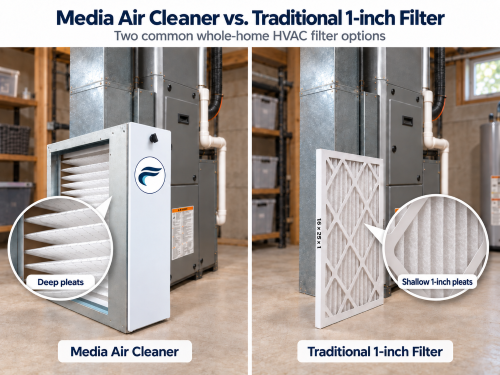
Rather than sliding a thin filter into a basic filter race, a media air cleaner uses a dedicated cabinet containing a deeper, pleated filter. The cabinet is professionally installed into the central HVAC system, typically in the return duct before the furnace or air handler.
As return air moves through the system, it’s directed through the media filter before being heated or cooled and redistributed throughout the house. Because the central HVAC system distributes air to multiple rooms, a media air cleaner provides filtration throughout the conditioned home rather than treating only one individual room.
Difference #1: More Filter Media Means Greater Capacity
One of the biggest differences between a standard HVAC filter and a media air cleaner is easy to see: depth.
Standard furnace filters are often approximately one-inch thick. Media filters can be several inches deep and use a pleated design to fit substantially more filtration material within the cabinet.
That additional surface area gives airborne particles more filter media to encounter as air passes through the system. It also gives the filter greater capacity to hold captured material.
Media should use depth loading to capture both larger and smaller particles while helping minimize pressure drop. Media Air Cleaners use electrostatically charged, hydrophobic media designed for efficiency, longer service life, and moisture resistance.
The result is a filtration solution designed to balance particle capture, capacity, and airflow rather than simply increasing filtration resistance.
Difference #2: Whole-House Filtration Can Capture More Airborne Contaminants
Not every HVAC filter captures the same contaminants. That’s where a filter’s MERV rating, or Minimum Efficiency Reporting Value, becomes important.
MERV provides a standardized way to evaluate a filter’s ability to capture particles between 0.3 and 10 microns. In general, higher MERV ratings indicate greater particle-capture efficiency within specified particle-size ranges.
MERV levels come in MERV 8, MERV 11, and MERV 13 configurations. MERV 8 filters are the basic, cost-efficient level that can handle larger particles. MERV 11 is a step above 8 that filters out anything that 8 can’t. MERV 13 filters take care of the rest.
For households concerned about dust, pets, seasonal allergens, or overall indoor air cleanliness, that additional filtration capacity from MERV 11 and 13 filters can make whole-house filtration an important upgrade.
Difference #3: Air Bypass Matters More Than You Might Think
Filter efficiency isn’t the only thing that determines filtration performance. The air actually has to pass through the filter.
If there are gaps around a filter or its cabinet, some air can find a path around the media rather than through it. This is known as air bypass.
Imagine installing a high-quality filter but leaving a gap beside it. Regardless of how efficiently the media captures particles, the air moving through that gap isn’t being filtered by the media at all.
In practical terms, better sealing helps ensure the air entering the air cleaner travels where it’s supposed to: through the filtration media.
Difference #4: Whole-House Filtration Helps Protect HVAC Equipment
Cleaner air isn’t the only potential benefit of better filtration.
Dust that isn’t captured by the filter can make its way farther into the HVAC system, where it may accumulate on components such as the blower and air handler. Over time, contamination can contribute to additional maintenance needs and interfere with system performance.
Whole-house filtration captures contaminants upstream before they reach these components. Better filtration serves two purposes: helping improve the air circulating throughout the home while also helping keep the equipment responsible for circulating that air cleaner.
Difference #5: Maintenance Can Be More Convenient
A common downside of standard 1-inch filters is frequent replacement.
Because the filter contains relatively little media, it can become loaded with contaminants more quickly, particularly in homes with pets, high dust levels, or heavy HVAC usage.
Deeper media filters provide greater holding capacity. Pleated media like the ones offered by Field Controls is designed with enough capacity to provide air cleaning for months while minimizing resistance to airflow.
Actual replacement intervals will always depend on factors such as HVAC runtime, household conditions, filter types, and manufacturer recommendations. Homeowners should inspect their filters regularly rather than assuming one replacement schedule works for every home.
Still, the media air cleaner’s increased capacity can mean fewer filter changes and more convenient maintenance compared with many traditional filter setups.
What Makes Field Controls HeavySeal(TM) Media Air Cleaners Different?
A whole-house media air cleaner isn’t simply a bigger filter. The cabinet, seal, media construction, and integration with the HVAC system all contribute to its performance.
Field Controls HeavySeal Media Air Cleaners are designed as low-maintenance whole-house filtration solutions that integrate directly into existing ducted HVAC systems. The current product line combines several important features:
- HeavySeal construction helps direct air through the filter and minimize bypass.
- MERV 11 filtration capture particles as small as 1.0 micron, including pollen, dust, mold, and dander.
- Deep pleated media provides high filtration capacity while helping minimize pressure drop.
- Electrostatically charged media enhances particle-capture efficiency.
- Moisture-resistant media helps resist conditions that support microbial growth.
- Heavy-duty metal construction creates a durable, permanent cabinet around the replaceable media.
Multiple sizes and configurations allow contractors to match the air cleaner to a variety of residential and commercial forced-air systems.
Field Controls’ current HeavySeal Media Air Cleaners are suitable for forced-air heating and cooling systems up to five tons, with model selection based on system requirements and airflow.
Whole-House Filtration Is One Part of Better Indoor Air Quality
It’s important to remember that filtration is designed primarily to address particulates. Even an advanced media air cleaner isn’t intended to solve every indoor air quality concern by itself.
Germs, odors, volatile organic compounds, humidity, and ventilation each present different challenges and may require different technologies.
That’s why Field Controls approaches indoor air quality as a system. Media filtration can capture particulates, while technologies such as UV-C purification can target biological contaminants and other air treatment solutions can address gases and odors.
For many homeowners, upgrading filtration is an excellent foundation. From there, an HVAC professional can evaluate whether additional indoor air quality technologies would benefit the home.
Which Type of Filter Is Right for Your Home?
A standard HVAC filter isn’t inherently a bad choice. Its suitability depends on what you expect your filtration system to accomplish.
If your primary goal is basic equipment protection and your home’s indoor air quality needs are minimal, a conventional filter may be adequate.
However, a whole-house media air cleaner may make sense if you’re looking for:
- Greater particle-capture capacity
- Improved filtration of dust, pollen, mold spores, and pet dander
- Longer-lasting filter media
- Better control of air bypass
- Whole-house filtration through your existing HVAC system
- Additional protection for HVAC components
Because airflow requirements differ between HVAC systems, homeowners should work with a qualified HVAC professional to determine the appropriate filter, MERV rating, cabinet size, and installation configuration.
Make Your HVAC System Part of Your Indoor Air Quality Strategy
Your HVAC system already moves air throughout your home. A whole-house media air cleaner takes advantage of that existing infrastructure to make filtration a central part of your indoor air quality strategy.
While a standard HVAC filter provides basic particle capture, a deeper media air cleaner offers greater filtration capacity, more surface area, and a purpose-built cabinet designed to direct air through the filter.
Field Controls’ HeavySeal Media Air Cleaners take that approach a step further by combining high-efficiency media with a tightly sealed, durable cabinet engineered to reduce air bypass and provide effective whole-house filtration.
For homeowners looking beyond basic furnace filtration, upgrading to a properly sized whole-house media air cleaner can be a simple but meaningful step toward cleaner air, cleaner HVAC equipment, and a more comfortable home.